

Last weekend, like millions of people, I watched the Super Bowl.
Not because I care about football—my wife and I are terrible fans. And not because of the halftime show, though it was incredible, even if I could only catch it in the ten-second windows between chasing my toddler around the house.
We’re Seattleites, so watching the Seahawks at their professional peak is practically municipal law. We gathered a few friends, filled every available counter space with snacks, and leaned into the ritual. Football culture. Or close enough.
And for a few hours, everything else stopped.
No work. No emails. No Slack pings.
As I watched the Seahawks hold back the Patriots, I realized that for the first time in months, I felt un-needed. I wasn’t checking Slack. I wasn’t tinkering on a side project. I wasn’t doom-scrolling. I was just... watching. Sitting. Being. Along with 120 million other people.
And I realized how rare that is—how rare the collective pause has become. Not the football. The permission. The feeling that for a few hours, nobody needed anything from me (or anyone else, maybe).
What felt so good wasn’t the game—it was sharing a moment at the same time, with no pressure to optimize it. We’ve lost our shared tempo. And that loss is deeper than missing a show: it’s about the disappearance of what I’ve come to think of as cultural third places—synchronized rituals that made being unreachable feel normal. When they vanish, work fills the void. Without meaning to, we’ve let it become the only tempo we share.
This is what we’ve lost. It’s time to bring it back.
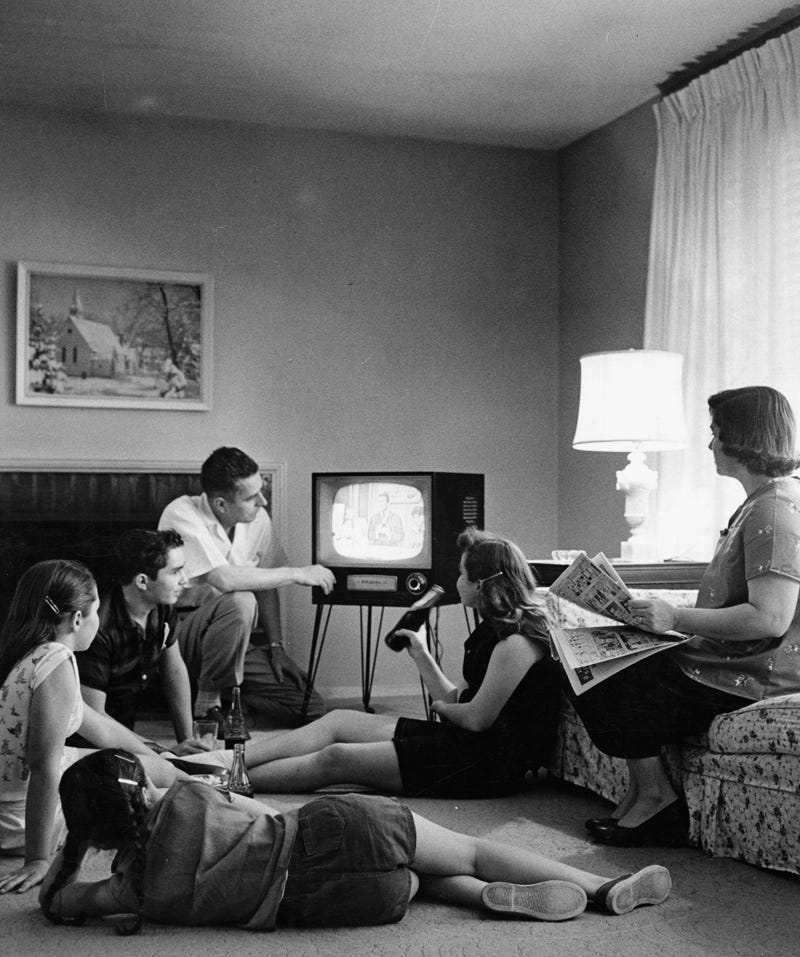
The fragmentation problem
This isn’t a plea to go back to three TV channels. It’s a plea to rebuild the shared rituals that let us exhale together.
We’ve abandoned something valuable in the march to endless personalization and on-demand content: the synchronized experience. The live moment you plan around, anticipate, and collectively share. The kind that doesn’t demand you curate, optimize, or justify your attention. This isn’t about conformity—it’s about connection.
In 1983, the MASH finale drew 83 million viewers—90% of American households gathered around a single story at the same moment. Nothing today comes close. Netflix alone added 589 original titles in 2024. Spotify serves up algorithmically personalized playlists. TikTok’s For You page shows you a feed that literally no one else will ever see.
The shift accelerated fast. By December 2025, Nielsen reported that streaming captured 47.5% of all TV viewing—a record—while cable dropped to just 20.2%, its lowest point ever. The shared screen splintered into millions of individual ones.
We’ve been sold fragmentation as freedom. More choices. More personalization. More you. But it’s come at a cost: no shared focus, fewer communal conversations, and an ever-shrinking window in which you and a colleague might have watched the same thing.
We’ve optimized for individual engagement and lost our collective rhythm in the process.
Work: the everything place
The default setting of modern life is: you are interruptible.
Used to be a weird ad on Super Bowl Sunday could dominate Monday’s chatter. Now the people you sit next to all have different digital lives, curated exclusively for them. A 2024 Gallup report found one in five employees feels lonely—for remote workers, it was worse. We’ve created a generation of workers who are endlessly productive but wildly disconnected.
Without shared rituals, boundaries evaporate. Work creeps into everything because there’s no structure pushing back. Slack’s Workforce Index found that employees who log off at the end of the day show 20% higher productivity than those who feel obligated to work after hours. The always-on culture doesn’t even deliver what it promises. It just burns us out faster.
When shared cultural scaffolding disappears, something replaces it, but poorly. Work becomes our everything place: our tether to belonging, structure, and identity. But unlike community, work’s rewards are conditional:
You belong as long as you perform
Your identity is as fragile as your job security
When layoffs land, you lose more than your paycheck, you lose your people
Even work can’t carry the weight we’ve placed on it.
The third place
In 1989, sociologist Ray Oldenburg coined the term “third place”—a space that isn’t home (first place) or work (second place), but somewhere else entirely. The café. The barbershop. The pub. The park bench. The library. Third places are defined by their leveling effect: status doesn’t matter, you’re not performing or producing, and the only price of admission is showing up.
We’ve been losing them for decades. Robert Putnam documented this in Bowling Alone—the steady erosion of civic life, community organizations, and the casual gathering spots that held neighborhoods together. Starbucks replaced the local café. Remote work emptied the office hallway. Suburban sprawl turned walkable gathering spots into parking lots.
But here’s what I’ve come to realize: we didn’t just lose physical third places. We lost cultural ones too.
Think about what the Super Bowl actually is. For three hours, 120 million people occupy the same cultural space. The game becomes the gathering place. The halftime show becomes the town square. You’re not competing or optimizing—just existing alongside millions of others in a shared moment. That’s a third place. Not a physical one, but a cultural one. And one of the last moments where the attention airspace clears—not by discipline, but by cultural permission.
We’re not just craving connection. We’re craving the safety that third places provide. In those spaces—physical or cultural—you don’t have to signal your taste or build your brand. You just are, unshackled from identity curation. Your choice to watch the same thing as everyone else stops being a statement about who you are. It becomes permission to just be there.
Émile Durkheim called this “collective effervescence”—the energy that emerges when a group shares a common focus at the same moment. It’s the same force behind concerts, stadium crowds, and packed dance floors. Algorithms can personalize your experience endlessly. They can’t manufacture that.
The MASH finale wasn’t just television. It was a town square for 83 million people. That’s what shared tempo built: cultural third places where showing up was the only requirement.
We’re running out of moments like this—places where it’s normal to be unreachable, where nobody even tries, because everyone’s in sync. Holidays used to do this well: not because the day was sacred, but because expectations dropped to zero. Nobody emailed on Christmas morning. Nobody Slacked on Thanksgiving. The shared ritual created a collective buffer that no individual boundaries conversation ever could. That’s what cultural third places do at their best—they don’t just bring us together. They synchronize our absence.
As work becomes more fragmented and precarious—as teams shrink, as the solo-creator economy grows—the need for cultural third places only intensifies. The Sunday scaries aren’t just about dreading Monday. They’re about facing another week without a place—physical or cultural—where you can stop being a professional and just be a person.
Rebuilding the third place
The hunger for shared tempo didn’t disappear—it just moved.
Twitch and Discord built massive communities around synchronous shared attention; millions watching the same stream, reacting together in real time. The resurgence of live events, from local comedy nights to community watch parties, reflects a craving for physical shared tempo. Even Spotify Wrapped works because it mass-synchronizes a cultural moment—everyone posting, comparing, and arguing about their results on the same day.
These are cultural third places. Not physical, but relational—built on shared rituals and synchronous attention.
We don’t need to go back to a world where everyone watches the same thing. We need shared rituals at the scale of a neighborhood, a workplace, a friend group. A team that watches the same documentary and talks about it on Monday. A community channel dedicated to a weekly live event. A block that gathers for the same meal once a month.
The key is reducing coordination friction—creating defaults that run without renegotiation. The Super Bowl works because it’s pre-coordinated. Nobody sends a group text asking “so are we watching?” Most shared rituals we’ve lost failed not because people stopped wanting them, but because every gathering became an individual logistics problem.
If it requires a group text every time, it isn’t a ritual yet. Make it recurring so your future self doesn’t have to renegotiate it. One or two anchors is enough. Lower the bar—the rhythm matters more than the quality.
The platforms and infrastructure exist. The question is whether we use them to extract attention or build connection.
Less, but better
AI is already pushing beyond the typical tech world and into every corner of how we live and work. More personalization. More noise. More addressability. The attention airspace is about to get a lot more crowded.
That means shared tempo becomes more valuable, not less. And the risk gets starker: if we don’t rebuild cultural third places, work will become the only organizing system left—the only place we get community, structure, identity, and rhythm. That’s not just unsustainable. It’s fragile.
Dieter Rams, the legendary industrial designer, had a principle: less, but better. We talk endlessly about portfolio careers—multiple income streams, side hustles, fractional roles. Fine. But we need portfolio lives. Lives with enough texture and dimension that our entire identity doesn’t collapse when a project fails or a job disappears.
That means building cultural third places deliberately. Deep hobbies you embrace for their own sake, not ones you monetize on YouTube. Experiences that exist outside a screen. And most of all, shared rituals you commit to on a recurring basis: the weekly dinner, the pickup game, the neighborhood show where everyone knows the band is mediocre but shows up anyway. These aren’t luxuries or nice-to-haves. They’re the third places we build when the old ones disappear.
The benefit of shared tempo was never the halftime show itself. It was what the halftime show created: a cultural third place where 120 million people had permission to care about something outside of work. Something that brought joy, health, and a kind of wealth we’ve stopped measuring.
Protect your attention airspace. Rebuild your shared tempo. The third place isn’t coming back on its own—we have to build it.
Until next time
If this landed for you, subscribe and pass it to one person who’d appreciate it.
I always enjoy hearing from you, so share your reactions, reflections, and/or questions.
Thanks for reading, and see you soon,
— Kevin K.
Elsewhere: Brief-Me · AccomplishIt · Uprise