Welcome back, friends.
As a reminder: Path Nine is a newsletter for people building their next chapter of work.
I used to think slide decks were useful. (Don’t judge.)
Not in a slide-monkey, consultant-brained way—even though I was previously both of those once. I mean I genuinely believed in the form.
A good deck requires thoughtful compression: you start with too much, cut until only the essential survives, and what you remove tells you more about what you actually believe than anything you kept. Amazon’s six-page memo is the deck’s less forgiving cousin. The writing itself wasn’t the deliverable. It was proof of thinking. You couldn’t write a serious six-pager without having actually thought through the details, because the page would expose you.
Now I read a deck, a doc, or any previously ‘thoughtful’ artifact, and I genuinely cannot tell whether there’s a mind behind it or a very good prompt. That’s a personal problem, but it’s also a cultural one. Whole institutions were built on the premise that the artifact carried the mind.
McKinsey.
Every law firm.
Every university that ever handed someone a credential.
None of them invented it.
That was the reason Socrates’ refused to write; and we ignored him for twenty-five hundred years to build the entire credentialing infrastructure of modernity on the artifact instead. That worked, until the artifact got cheap.
Now anyone can generate a doc, a deck, and much more (with much less effort). In fact, I’m sure there’s already a good six-pager prompt or Claude skill out there. The ten slides that used to be three weeks of work, now done in minutes.
What that does to a culture built entirely on the idea of intelligence as artifact is hollow it out from the inside. The forms and frameworks are still there, but the discipline that gave them weight isn’t.
If the artifact no longer proves the thinker, where did the thinking ever really live?
A mind was once in there
For most of history, the artifact verified itself. When someone handed you a dense, well-argued piece of writing, you didn’t need to audit the thinking behind it. The document was the evidence. Whoever made this had done the work.
But now, that line between labor and insight has all but vanished. AI can now give us artifacts that look like proof, with almost no visible effort. The problem isn’t that AI has made thinking obsolete, it’s that work is no longer legible proof of thought.
A polished document used to mean something. It used to signal: this person sat with an idea long enough to shape it or at least assemble it. Now it might just mean someone knows how to craft a solid prompt. Sure, that’s a newly valuable skill, but from the outside, you can’t tell which it is, and increasingly, neither can the person who wrote it.
This confusion has a name, one that predates any AI-related conversations.
Bernard Lonergan spent most of his career diagnosing exactly this—though he was writing about epistemology in the 1950s, not AI. His central argument was that we have a deeply mistaken model of what knowing actually is. We treat it as a kind of looking. As though intelligence were something you could see in an artifact the way you see an object on a table. Observe the thing; confirm the thought. He called this “knowing as taking a look,” and he thought it was the foundational error of Western epistemology.
He was right then. He’s more right now.
Knowing was never in the artifact. It was always in the act. We just didn’t have to care about that distinction until the artifact got cheap.
The ascent, not the artifact
If the tests we used to use to verify thinking can now be taken by a machine, what verifies thinking?
Lonergan’s answer—which I mostly agree with—is that knowing was never in the artifact, it was in the ascent.
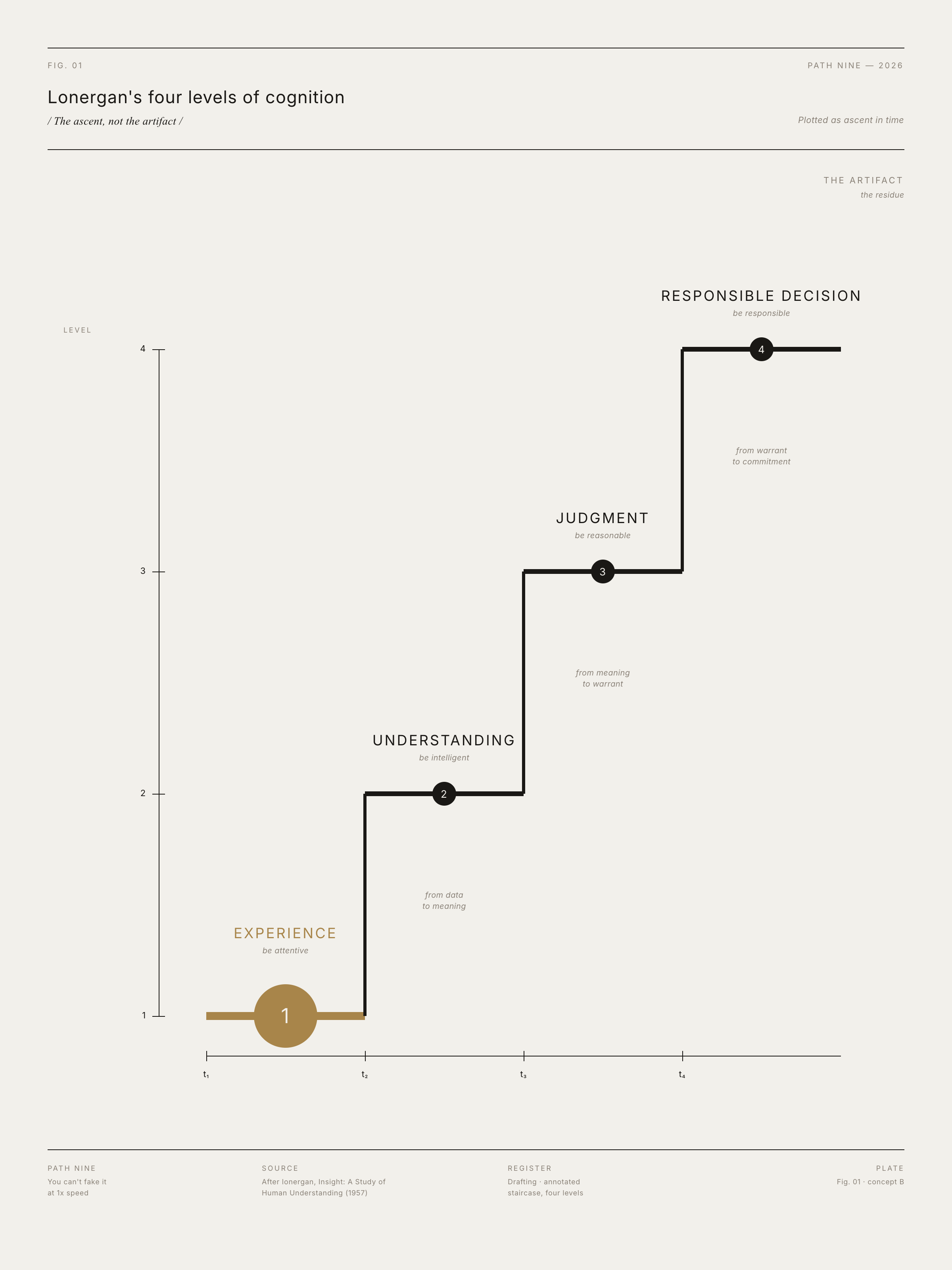
He argued that genuine cognition moves through levels—from raw experience, through understanding, to judgment, and finally to the responsible act of deciding what to do with what you’ve concluded. Each level requires the one below it. You can’t judge what you haven’t understood. You can’t understand what you haven’t attended to. The artifact was always just the residue of that climb. We confused the residue for the climb itself. The means for the end; the map for the territory.
His four precepts for authentic thought were almost insultingly simple:
be attentive,
be intelligent,
be reasonable,
be responsible.
They’re not destinations, they’re directions.
The document doesn’t prove you were any of those things; it only convinced us it did, until it didn’t.
So what can prove it?
The quality of the questions you ask.
The judgment calls you make when the output needs to change.
The capacity to sit with a problem and resist the urge to reach for a tool that’ll just generate something in your direction.
These are what Lonergan would recognize as evidence of the actual ascent—not the document or deck at the top, but the climb itself.
You can’t fake it at 1x speed
So, what happens next?
One easy answer—and the one I really don’t love—is to stop caring about the old ways altogether. We collectively decide that cognitive performance isn’t something we can verify anymore, so we stop trying. Credentials shift to proxies: pedigree, confidence, the fluency of the output. We get very good at producing the signals of intelligence while the underlying capacity quietly goes unmeasured. At some point we stop noticing the difference, and then we stop caring that we stopped noticing. That future is more plausible than I want it to be. It requires no effort and resolves the tension without doing the work.
But I don’t think that’s necessarily inevitable. And the reason I don’t is that I keep noticing that the pressure to verify thinking hasn’t fully disappeared. It’s just migrated to the places where you can’t fake it (yet).
The 1x speed zones.
Hiring is an obvious place to start.
Video interviews were already becoming standard, and I think they’re about to become load-bearing in a way nobody fully anticipated. Not because video is special, but because thinking in real time—without an LLM running in another tab, without the fifteen-second buffer to generate a polished response—is one of the few things that still differentiates a person (human?) from a very good prompter.
The question you ask when you’re surprised.
The way you respond when when pushed, or react when the argument actually lands.
You can’t fake that at 1x speed with someone watching.
Conversation matters for the same reason. Not networking-event conversation, the performance of it, but the kind where you’re actually building something in real time with another person and the output only exists because both minds showed up. There’s a rhythm to it. Two people finding it together, each beat contingent on the last. That can’t wait for a model to finish generating. The delay breaks the dance.
That’s verifiable in a way a document isn’t anymore.
It requires you to evaluate on the fly, to discard bad framings before they’re fully formed, to do the thing that AI genuinely can’t do (yet): track the texture of what someone else actually means rather than what they literally said.
You see it in extemporaneous speech—the debate format where you get thirty seconds with a topic and then you go.
You see it in live podcasting, unedited, where the thinking is the tape.
You see it in video calls where someone has to explain something they half-understand and you can watch, in real time, the moment they reach the edge of what they actually know.
Which means the premium is going to shift.
Not away from tools—AI isn’t going anywhere, and anyone who tells you the answer is to just stop using it is selling something. But the ability to evaluate well is going to matter more, not less. To know when the output is off. To ask the question the model didn’t think to ask, because it doesn’t actually think. That’s not a prompting skill, it’s a thinking skill. And thinking still matters, no matter how difficult to verify it becomes.
The pressure to verify thinking never disappears. It just finds new places to land. New systems will come. When they do, the question is whether enough people will have maintained the necessary savvy to make sense of them, to make the climb possible.
And keeping those skills—deliberately, against the grain—turns out to be the one thing that AI can’t automate.
Until next time
If this landed for you, subscribe and pass it to one person who’d appreciate it.
I always enjoy hearing from you, so share your reactions, reflections, and comments.
Thanks for reading,
— Kevin K.
Recent posts worth exploring: